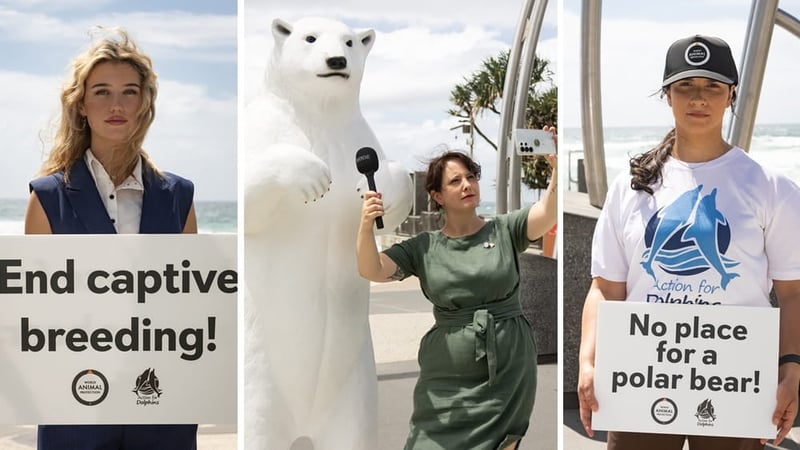
Frosty the ‘polar bear’ sends a strong message to Sea World on the Gold Coast
News
With your support, we recently called Sea World on the Gold Coast (Queensland, Australia) to end the captive breeding of polar bears and dolphins for entertainment. Local TV and radio stations captured the action, spreading our message far and wide.
Image credit: Carol Slater
Thanks to your support, our polar bear mascot took a stand together with a group of animal welfare advocates at popular tourist spot, Surfers Paradise, calling for an end to the cruel captive breeding of polar bears and dolphins.
Together, we educated members of the public about the hidden suffering behind this practice.
Watch the stunt:
Frosty the ‘polar bear’ also caught the eye of many people passing by, who stopped to take photos and share their shock. Some expressed regret about having visited Sea World.
The action not only captured the attention of the public, but also garnered media coverage in outlets, amplifying the urgent need for change.
With you by our side, we launched our ‘No Substitute for the Wild’ report with Action for Dolphins, which made the case for a breeding ban on polar bears and dolphins in Queensland.
As part of our campaign launch, more than 5,000 animal lovers across Australia and Aotearoa New Zealand were moved to stand up for wildlife and send letters to Sea World and the Queensland government.
Together, we can create a world where wild animals are no longer bred in captivity for entertainment.
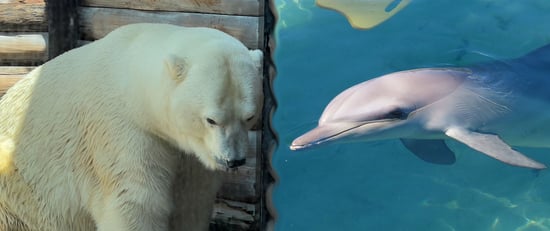
Protect polar bears and dolphins
Raise your voice for polar bears like Mishka and dolphins like Huey at Sea World on the Gold Coast in Australia.
FAQs
Why should Sea World stop captive breeding polar bears?
Right now, Sea World is keeping polar bears, who are adapted to cold Arctic environments, in the hot Gold Coast climate. In the theme park's self-proclaimed “world-class” enclosures, they have only a fraction of the space they would have in the wild. A polar bear cub born at the venue today could still be on display at the venue in 2050.
Why should Sea World stop captive breeding dolphins?
Dolphins, who can cover up to 100 kilometres a day in the wild, are made to live in an artificial lagoon that could never truly replicate their wild homes. On top of this, they’re repeatedly exposed to the loud noise of rollercoasters, helicopter flights, and crowds. A dolphin calf born at the venue today could still be performing in 2070.
Can a theme park like Sea World replicate a wild animal’s natural habitat?
A theme park can never truly replicate the natural habitat for a polar bear or dolphin. While Sea World claims its enclosures replicate natural environments, our latest report with Action for Dolphins shows that a theme park cannot match the Arctic conditions polar bears evolved for or the vast, open waters dolphins explore in the wild.
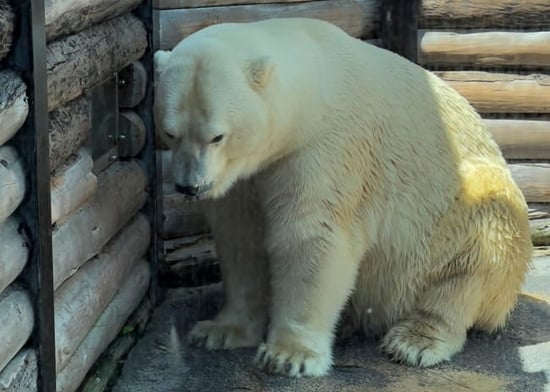
No Substitute for the Wild
Read our ' No Substitute for the Wild ' report that examines the implications of continuing to breed animals into captivity in Queensland.
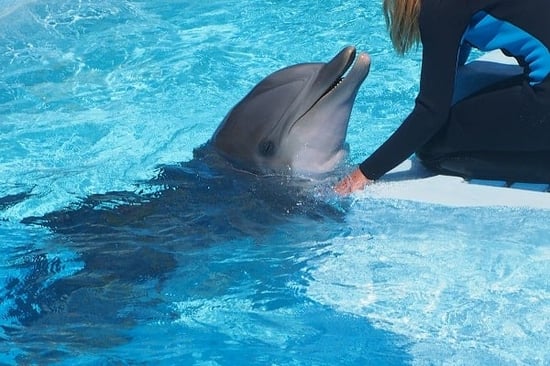
Donate to protect dolphins
Dolphins are intelligent and sociable wild animals. They belong in the ocean, not bred in captivity for entertainment.